
(EC) eGovernment Benchmark 2020: eGovernment that works for the people
Date of article: 24/09/2020
Daily News of: 25/09/2020
Country:  EUROPE
Author:
Article language: en

The 2020 eGovernment Benchmark report shows remarkable improvements across the board: Over the last two years, every one of the 36 countries measured has improved the digital delivery of public services according to the four benchmarks considered in the assessment. However, the scale of improvement and the overall performance vary substantially.
ssessment. However, the scale of improvement and the overall performance vary substantially.
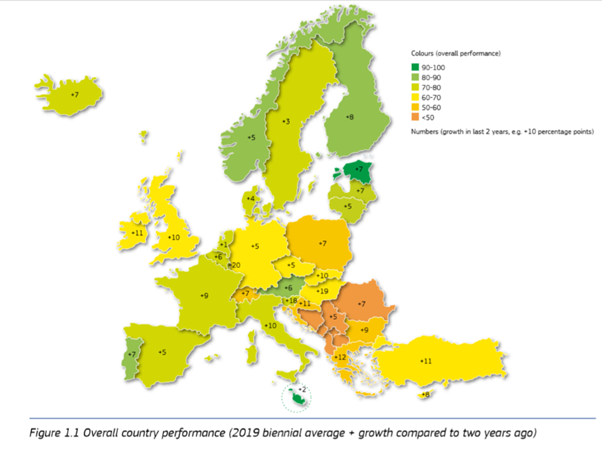
The European frontrunners in eGovernment are Malta (overall score of 97%), Estonia (92%), Austria (87%) and Latvia (87%). These countries score highest across all four top-level benchmarks, followed closely by Denmark (84%), Lithuania (83%) and Finland (83%).
In terms of progress, Luxembourg, Hungary and Slovenia have made the greatest advances in the last two years, rising with 20, 19 and 18 percentage points respectively, resulting in corresponding overall scores of 79%, 63% and 72%.
How is performance measured?
In order to give a consistent and repeatable means of making valid comparisons, performance of online public services is evaluated against four “top-level” benchmarks. The average score of the four top-level benchmarks represents the overall eGovernment performance of a country, from 0% to 100%
Overall performance is measured as an average score of four top-level benchmarks (which each comprise multiple sub-indicators):
-
User Centricity – To what extent are services provided online? How mobile friendly are they? And what online support and feedback mechanisms are in place?
-
Transparency – Are public administrations providing clear, openly communicated information about how their services are delivered? Are they transparent about the responsibilities and performance of their public organisations, and the way people’s personal data is being processed?
-
Key Enablers – What technological enablers are in place for the delivery of eGovernment services?
-
Cross-Border Mobility – How easily are citizens from abroad able to access and use the online services
These benchmarks are assessed on the basis of a set of eight life events. Each life event consists of a user journey representing common public services that citizens or businesses will go through. Four life events are measured each year. Hence, the 2020 report presents the findings for data collected in 2018 and 2019.
The data to assess these indicators are collected by Mystery Shoppers. Mystery Shoppers are citizens of each of the observed countries who act as prospective users and follow a detailed, objective and standardised evaluation checklist. The Mystery Shopping has recently been complemented by automated open tools for the assessments of Mobile Friendliness and Cybersecurity.
Where Does Europe Stand?
The EU27+ overall performance stands at 68%. Two years ago, the overall performance sat at 62%.
User Centricity: The focus on end user experience has seen this top-level benchmark increase to 87% (4 percentage points higher than two years ago). More than three out of four public services can be fully completed online (78%). Users can find the services they are looking for via portal websites 95% of the time, and information about these services online nearly 98% of the time.
Of the three sub-indicators, the most recent one, Mobile Friendliness, scores lowest, albeit having seen the highest increase, up from 62% two years ago to 76% today.
(...)