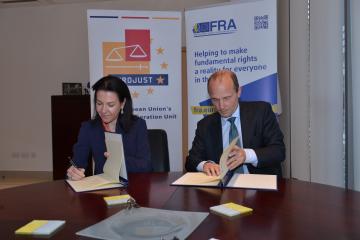
Signature d’un protocole d’accord entre Eurojust et la FRA

Date of article: 03/11/2014

Daily News of: 04/11/2014

Country:  EUROPE

Author:

Article language: fr

L’Unité de coopération judiciaire de l’Union européenne (Eurojust) et l’Agence des droits fondamentaux de l’Union européenne (FRA) ont signé un protocole d’accord au Bureau européen d’appui en matière d’asile (EASO) à La Valette (Malte), le 3 novembre.

Mme Michèle Coninsx, présidente d’Eurojust, et M. Morten Kjaerum, directeur de la FRA, ont signé le protocole d’accord durant la réunion des agences de l’UE chargées de la justice et des affaires intérieures, qu’accueillait l’EASO. Était également présent M. Klaus Rackwitz, directeur administratif d’Eurojust.

Le protocole d’accord fut approuvé par le Conseil de l’Union européenne le 8 octobre 2014. Il vise à établir, à définir, à encourager et à renforcer la coopération entre les deux agences. Dans le cadre de ce protocole, les agences créent des points de contact afin de coordonner les activités de coopération, et peuvent échanger des informations stratégiques et techniques.

© TufignoPhotoService

Read more

Eurojust and FRA sign Memorandum of Understanding

Date of article: 03/11/2014

Daily News of: 04/11/2014

Country:  EUROPE

Author:

Article language: en

The European Union’s Judicial Cooperation Unit (Eurojust) and the European Union Agency for Fundamental Rights (FRA) signed a Memorandum of Understanding (MoU) at the European Asylum Support Office (EASO) in Valletta, Malta on 3 November.

Ms Michèle Coninsx, the President of Eurojust, and Mr Morten Kjaerum, the FRA Director, signed the MoU during the meeting of EU Justice and Home Affairs Agencies which is being hosted by EASO. Also in attendance was Mr Klaus Rackwitz, Administrative Director of Eurojust.

On 8 October 2014, the Council of the European Union approved the MoU. Its purpose is to establish, define, encourage and improve cooperation between the two agencies. Under the MoU, the agencies establish contact points to coordina

© TufignoPhotoService

Read more

Promotion of a guide in Macedonian language for the articles 5 and 10 of the European convention on human rights

Date of article: 24/10/2014

Daily News of: 04/11/2014

Country: Former Yugoslav republic of Macedonia

Author:

Article language: en

PROMOTION OF A GUIDE IN MACEDONIAN LANGUAGE FOR THE ARTICLES 5 AND 10 OF THE EUROPEAN CONVENTION ON HUMAN RIGHTS24.10.2014, Skopje
“The right to personal liberty and security from one side and the freedom of expression on another, represent a pre-condition for exercising many other rights, but also a pre-condition for a functional democracy. If the democratic process cannot be imagined without a respect of the basic human freedoms and rights, hereby including the right to personal liberty and security, then neither the democracy as such cannot be imagined without tolerance and pluralism, without a possibility for a freedom of personal opinion, freedom to receive information and ideas and freedom to send information and ideas“ .This among others was emphasized by the deputy Ombudsman Ms. Vaska Bajramovska-Mustafa at the promotion of the translation in Macedonian language of the publications “Guide to the Article 5-Right to Liberty  and Security” and “Report from the Research-Positive Obligations on Member States under Article 10” from the European Convention on Human Rights.

During her speech Ms. Bajramovska-Mustafa stressed the importance of the translation and the publication of this legal document in Macedonian language for the purpose of improvement of the knowledge of all those who work in the field of human rights, in particular the bodies that meritoriously decide about deprivation of liberty, the citizens’ defenders in procedures before a responsible court.

The translation of these publications was in cooperation with the Ombudsman of the Republic of Macedonia, the German Foundation for International Legal Cooperation, the Academy for Judges and Public Prosecutors of the Republic of Macedonia “Pavel Shatev” and the Chamber of Attorneys of the Republic of Macedonia.


Read more

Complaints about Independent Care Providers

Date of article: 01/11/2014

Daily News of: 04/11/2014

Country:  United Kingdom - Wales

Author:

Article language: en

From 1 November 2014, the Public Services Ombudsman for Wales’s jurisdiction changed. This is as a result of the Social Services and Well-being (Wales) Act 2014. He now has an extended role in relation to care homes, domiciliary care and palliative care services.

The Ombudsman has always been able to consider complaints made by individuals whose care has been arranged by public services (or by someone acting on their behalf), for instance in care homes. The new arrangements, however, now mean that he can also consider complaints from people who arrange and fund their own care.

In respect of independent palliative care services, this is a new area in jurisdiction. In this case, in order for the Ombudsman to be able to consider a complaint, the service must have received public funding (e.g. from a health board or council) in the past three years prior to the matter being complained about.

Further information about complaining about these services are available in the booklet here.

Read more