L’institution du bureau du Médiateur suit avec une profonde inquiétude les mouvements de protestation qui ont commencé au Théâtre national
Il y a deux jours, notre institution avait déjà commencé à examiner la demande de l’Alliance pour le théâtre concernant les aspects de la prise de décision du Conseil des ministres, puis celle du Conseil municipal de Tirana, dans la mesure où ils peuvent violer les droits de l’homme.
L’Avocat du peuple a été informé par les médias que vers 4h30 du matin, de nombreuses forces de l’Inspection de la construction de Tirana, soutenues par la police municipale et la police d’État, sont intervenues dans la construction du Théâtre national. Les forces de la police d’État sont entrées dans le bâtiment et ont détenu de force certains des citoyens présents.
The events of the last few days, in the midst of the COVID-19 pandemic and following the death of George Floyd, have prompted an amplification of the racial justice movement in the United States that is resonating everywhere in the world, including in Europe. This blogpost aims to give some insight into this movement from a systemic racism point of view, highlighting how this is far from an isolated incident, but a part of a whole system of oppression that needs dismantling.
Racism – the terms
There is much talk about systemic, structural and institutional racism. But what is this, how does it manifest, and what is its relationship with the US incidents and the disproportionate impact of COVID-19?
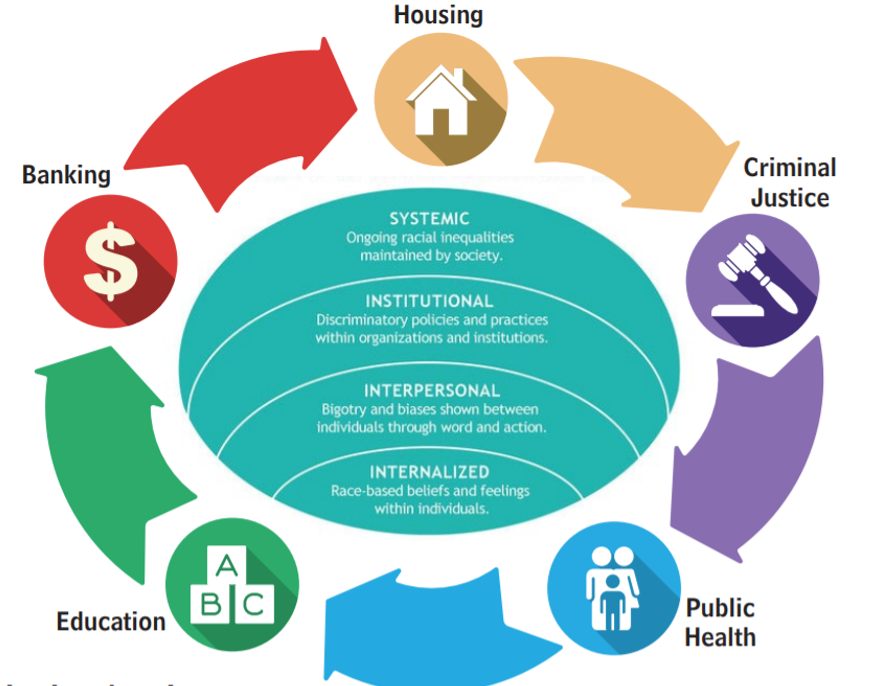
Systemic racism is a term to designate the whole societal structure that maintains a racially oppressive system that privileges and oppresses different racial groups in society. Manifestations of systemic racism are for instance, structural and institutional racism. Institutional racism refers to the systematic racial bias inferred into policies or laws as well as its practice (e.g. enforcement and judicial systems). Such bias can be explicit or made by systematically ignoring the needs of minorities. Meanwhile, structural racism refers to inequalities rooted in the system-wide operation of a society that excludes substantial numbers of members of particular groups from significant participation in major social institutions.
These should be distinguished from interpersonal racism, which refers to the external representations of bigotry and biases shown between individuals; and internalised racism, which does not require an external representation, but is within every individual due to their belonging to the systemically racist society.
Just as the initiative Race Forward explains, systemic racism can manifest itself in different forms and impact a myriad of fields, such as the wealth gap, employment, housing discrimination, education, banking or public health access, government surveillance, incarceration, drug arrests, immigration arrests, infant mortality…
The homicide of George Floyd in the US city of Minneapolis was the spark that has prompted protest movements across the US and the rest of the world. Few people will have missed the video of George Floyd’s arrest and death. But this is not an isolated incident and should not be confused with the starting point of a global anti-racist movement. Since 2013, #BlackLivesMatter has been documenting the racist incidents caused by white supremacy. #SayHerName is a social movement founded by the African American Policy Forum (AAPF) and the Center for Intersectionality and Social Policy Studies (CISPS) that aims at raising awareness for black female victims of police brutality and anti-black violence in the US. Both initiatives gather data on racially motivated violence from public authorities. Decades of activism from the antiracist civil rights activists in the US have also paved the way for these movements.
The same day that George Floyd died, the recording of an incident in Central Park was made public in which a white woman called the police, with no apparent reason, claiming that an African-American man (and she repeated that he was African-American multiple times) was threatening her life. Why is this important? Because she insisted on identifying the man (who was not threatening her) as black. Antiracist activists have consistently pointed out that only someone sure that stating that fact would give her an advantage due to entrenched racial stereotypes in the police forces, would have made the point so many times.
What is necessary to understand is that the protests and the recent movements do not have one root and were not born when George Floyd was killed by a policeman last week. This has only been the most recent of thousands of deaths, and the tip of the monumental iceberg of systemic racism. The protests claim justice for all of it, not only for the death of George Floyd.
COVID-19, the background
On top of the outrage that has followed the events mentioned above, studies have shown that ethnic minorities are being affected in a much more extensive way by COVID-19. The UN High Commissioner for Human Rights Michelle Bachelet declared a few days ago that “the data tells us of a devastating impact from COVID-19 on people of African descent, as well as ethnic minorities in some countries, including Brazil, France, the United Kingdom and the United States. In many other places, we expect similar patterns are occurring, but we are unable to say for sure given that data by race and ethnicity is simply not being collected or reported”. The lack of ethnically disaggregated data in most European countries, as pointed out by Bachelet, underlines, once again, the need for systematic disaggregated equality data collection.
In the UK, the Office for National Statistics (ONS) published on 7 May a brief titled “Coronavirus-related deaths by ethnic group, England and Wales: 2 March 2020 to 10 April 2020”, showing that black men in the UK are 4.2 times more likely to die from COVID-19 than their white counterparts, while showing that ethnic minorities in general were more likely to die from COVID-19.
Clyde W. Yancy, MD, MSc, from the Department of Internal Medicine of Northwestern University, stated that in Chicago, more than 50% of COVID-19 cases and nearly 70% of COVID-19 deaths involve black individuals, although blacks make up only 30% of the population. In Sweden, Finland and Norway it has been reported that minorities, such as Somalis, are also being disproportionately affected by COVID-19.
On top of this, several studies (for instance here) have shown that Black and minority ethnic workers make up a disproportionately large share of key worker sectors. This implies that being a majority of the key worker sector, they are more exposed to contract the virus, on top of being more likely to die because of it.
The ‘other’ pandemic in Europe
The protests in the US have served to highlight both the symptoms and the disease: racism. And much as with COVID-19, no country is safe.
Regarding law enforcement and police bias, the European Network Against Racism (ENAR) stated that racial profiling and police violence on the continent during the ongoing COVID-19 pandemic is disproportionately affecting ethnic minority communities. Equinet published a series of outputs regarding Ethnic and racial profiling in 2019, analysing the practice, what national equality bodies are doing, and sharing good practices while making recommendations to address the outlined challenges.
There is plenty of data about incidents in the EU during the last years regarding systemic racism against different ethnic groups. Taking into account the perceived underreporting from minority communities, it is safe to assume that the cases are larger in number than those that will be mentioned in the following lines. However, compared to the death of George Floyd, it seems that these widespread racist incidents did not spark general outrage in European societies even though there are plenty of manifestations of systemic racism on European soil, as well.
In Belgium, just a few weeks ago, Adil, a 19-year-old teen of Moroccan descent — was killed during a police chase in Brussels while allegedly fleeing from a police check. His death followed that of Mehdi, a 17 year old man that was run over by a police car. Their deaths sparked protests in their neighbourhoods but did not mobilise the wider society.
The NGO ROMEA has recently shared the video of the death of the Romani man Miroslav Demeter in Žatec, Czech Republic four years ago. The 27-year-old man died in very similar circumstances to George Floyd on 18 October 2016 in the Panamera Pizzeria after a conflict with customers led to an intervention by local police officers. Recordings of the incident show how Miroslav is forcefully immobilized by the police. Violence was used against Miroslav, and he complained until he simply stopped moving. In February 2017, the investigation was closed, and Miroslav’s death was deemed to be caused by drug use and not by anyone’s use of force. His death did not spark general outrage in his country.
In 2019, new evidence came to light in the case of Oury Jalloh an asylum seeker in Germany that was believed to have committed suicide by burning himself; suggesting that jail officials were somehow involved in the incident, given that he sustained significant injuries before his death. This death did not spark general outrage either.
In 2012, Spain was condemned by the European Court of Human Rights (ECtHR) and ordered to pay a sum to a black Nigerian woman for ineffective investigation of racially motivated ill-treatment and racial slur from police officers. In 2011, Mark Duggan, a black British citizen was shot by the police. His death was found to be lawful.
These examples of police violence and racism are only the tip of the iceberg and can be traced back to the larger issue of systemic racism in our societies. As mentioned above, systemic racism manifests itself in very different ways. The EU Fundamental Rights Agency (FRA) published a report last year that analysed discrimination faced by black persons in the EU. This study showed, for instance that “black people in the EU face unacceptable difficulties in simply finding somewhere to live or getting a decent job because of their skin colour.” Additionally, 30% of respondents said that they had been racially harassed in the last five years, while 5% had been physically attacked. FRA advised, that “Member States should therefore make greater efforts to better support victims of racism and to properly prosecute perpetrators.” Likewise, ENAR published in 2017 a report called “Justice gap: racism pervasive in criminal justice systems across Europe”, highlighting the inherent racism of justice systems.
What are Equinet and national equality bodies doing?
We remain at your service. Always. National Equality Bodies are bodies mandated to protect citizens from discrimination and abuse. They do this by investigating cases of discrimination; building a culture that values equality; providing information and in some cases legal support to potential victims; monitoring and reporting on discrimination issues; conducting research and providing policy recommendations and engaging with public bodies, employers and NGOs to foster non-discriminatory practices and ensure awareness and compliance with equal treatment legislation. You can find a list of National Equality Bodies here.
There are many examples of good practice initiatives by NEBs. Earlier this year, for instance, Unia in Belgium created a supervisory committee on racism, following the example of an earlier one created around disability, together with academics, social partners and CSOs. The aim of this committee is to create a space for dialogue and listening to feed Unia’s work and expertise in the area. In this sense the committee would be able to give their insights about Unia’s work on the area.
Much like the #metoo movement did before, the recent amplification of the racial justice movement in the United States is resonating everywhere in the world, including in Europe. More people are finally hearing what black anti-racist activists have been saying all along, in the U.S. and Europe, and it will necessarily change the way we understand the world and equality. But it won’t change until everyone of us reflects and decides to fight racism every day. It also won’t change unless we question the foundations of systemic racism in our societies. This is the time to learn and understand. To listen. Only then can the very necessary changes that we need to make have real effects.
Photo credit: Jone Elizondo-Urrestarazu, Legal and Policy Officer at Equinet
The views on this blog are always the authors’ and they do not necessarily reflect Equinet’s position.
Es necesaria una evaluación precisa de la situación de cada niño, adolescente o joven migrante en condiciones de vulnerabilidad, y buscar en cada caso el recurso más adecuado a sus necesidades
Todas las administraciones deben fomentar acciones destinadas a combatir la integración de los menores de edad migrantes en sus municipios y actuar contra la xenofobia
La institución alerta acerca de las situaciones de gran vulnerabilidad de las chicas migrantes no acompañadas, a menudo más invisibilizadas, que requieren una atención muy especial y medidas específicas de apoyo y acompañamiento
Es imprescindible la coordinación entre la DGAIA y los ayuntamientos para detectar y abordar situaciones de niños y jóvenes en situación de gran vulnerabilidad social
El Síndic de Greuges ha publicado una resolución relativa a la situación de vulnerabilidad de los niños y adolescentes migrantes ante la crisis de la Covid-19. En los últimos años la institución ha velado por los derechos de los niños migrantes no acompañados, tanto a través de la resolución de quejas y actuaciones de oficio como con su Informe extraordinario sobre la situación los niños migrantes sin referentes familiares en Cataluña, presentado en el Parlamento de Cataluña en el año 2018.
Ante las medidas requeridas para gestionar la crisis de la Covid-19, los niños, adolescentes y jóvenes migrantes en condiciones de vulnerabilidad merecen una atención especial. Aunque no es una población de riesgo grave en relación con la enfermedad, las recomendaciones requeridas de confinamiento y otras pueden no ser idóneas para su protección.
De esta manera, la institución ha elaborado una serie de recomendaciones que abordan la situación de los niños, adolescentes y jóvenes migrantes no acompañados en situación de vulnerabilidad, realizando una mención especial a los niños y adolescentes migrantes sin referentes familiares a Cataluña que pueden haberse fugado de centros de protección o ser refractarios a las medidas de protección de la Administración, jóvenes mayores de edad que no tienen regularizada su situación residencial o que no se encuentran en el circuito de apoyo al joven tutelado y extutelado o chicas migrantes no acompañadas o que han sido víctimas de tráfico de seres humanos con fines de explotación sexual.
La falta de vivienda, la dificultad para encontrar un puesto de trabajo, problemas de adicciones y/o salud mental, situaciones de maltrato, tráfico y explotación, y la falta de apoyo familiar y social son situaciones de gran vulnerabilidad de niños y jóvenes que merecen una atención especial en estos momentos, con medidas de apoyo y acompañamiento extraordinarias ante el contexto provocado por la pandemia de la Covid-19. En consecuencia, es necesaria la coordinación interadministrativa entre la DGAIA y los ayuntamientos de los diferentes territorios, así como entre las administraciones, para detectar y abordar situaciones de niños y jóvenes en situación de gran vulnerabilidad social.
En este sentido, también es necesario fomentar acciones destinadas a prevenir la discriminación y la xenofobia. Los poderes públicos deben garantizar el principio de igualdad y eliminar cualquier discriminación a niños o adolescentes, los cuales deben identificar individualmente o en grupo, cuando se requiere la adopción de medidas protectoras especiales para reducir o eliminar factores de discriminación. En consecuencia, las acciones destinadas a promover la integración de los menores de edad migrantes en los municipios son fundamentales para dar una respuesta integral a sus necesidades, asñi como para evitar y reducir el riesgo de hostilidades y actitudes de discriminación social hacia este colectivo en el territorio.
El Síndic de Greuges de Cataluña continúa trabajando en su tarea de defender los derechos de los niños migrantes no acompañados. En este sentido, dirige una serie de recomendaciones al Departamento de Trabajo, Asuntos Sociales y Familias y a los ayuntamientos de cada provincia de Cataluña. Es necesario el pleno respeto a los principios y derechos recogidos en la Convención sobre los derechos del niño. Así, la institución insta a las administraciones públicas a extremar los esfuerzos de coordinación y actuación interadministrativa, a llevar a cabo una evaluación precisa de la situación individual de cada niño, adolescente o joven migrante en condiciones de vulnerabilidad y buscar en cada caso el recurso que sea más adecuado para la cobertura de sus necesidades y de acuerdo con las recomendaciones requeridas para gestionar la crisis de la Covid-19.
La institución pide que la DGAIA, en coordinación con los ayuntamientos de municipios que tengan centros de acogida, residenciales y pisos tutelares con niños migrantes, adopten las medidas de protección, apoyo y acompañamiento que sean necesarias en el contexto actual, de acuerdo con el interés superior de los niños o adolescentes que se encuentren en situación de alto riesgo social o jóvenes ex tutelados en situación de exclusión social.
En lo que respecta a la atención de los niños o adolescentes en situación de vulnerabilidad, pide que los equipos técnicos pertinentes realicen planes individualizados de atención que respondan a las necesidades y a los intereses de cada uno de ellos. Asimismo, es preciso alertar sobre la situación de gran vulnerabilidad de las chicas migrantes no acompañadas, a menudo más invisibilizadas, que requieren una atenciónmuy especial y medidas específicas de apoyo y acompañamiento en el actual contexto de crisis por Covid-19. En este sentido, es imprescindible pedir que la DGAIA y los ayuntamientos municipales asuman un compromiso unánime para hacer frente a cualquier acto de xenofobia hacia personas migrantes menores de edad.
At the meeting of the Seimas Committee on Human Rights, the issue of ensuring human rights in the institutions subordinated to the Prison Department during an emergency situation was discussed. During the meeting, Augustinas Normantas, the Head of the Seimas Ombudsmen‘s Office, drew the attention of the participants to the fact that quarantine conditions are currently being mitigated; therefore, it is necessary to talk about quarantine mitigation measures in correctional facilities.
The Chairman of the Committee on Human Rights, Valerijus Simulik, welcomed the fact that during this extremely difficult situation, the number of complaints from convicts was not very high and this was due to the constant monitoring of human rights by the Seimas Ombudsmen.
Speaking about the situation in correctional facilities during the pandemic, the Seimas Ombudsman noted that at the beginning of the introduction of quarantine the situation caused a great deal of uncertainty and anxiety, so he had to contact the Ministry of Justice and the Prison Department, drawing their attention to potential problems concerning ensuring of human rights in places of detention during qurantine.
"In addressing the responsible authorities, we have proactively sought to recall international human rights standards that should apply during a pandemic in the democratic state. By addressing the heads of the institutions, we encouraged the updating of emergency plans, the provision of the necessary protection measures and the information of employees and convicts on how to behave during a pandemic,” noted A. Normantas.
The Head of the Seimas Ombudsmen's Office also pointed out that after the imposition of quarantine there were fears regarding fostering of contact between convicts and their relatives, therefore the letters were prepared and sent to correctional institutions with an aim to draw their attention to the necessity of ensuring remote communication of convicts with their relatives. Virginijus Kulikauskas, the Head of the Prison Department, admitted that organization of remote communication of convicts with their relatives helped to manage the psychological tension in the places of imprisonment. Moreover, he assured that during the whole quarantine period the possibility for convicts to call their relatives was not restricted.
"At the beginning of the quarantine, we received complaints from convicts regarding the lack of communication with relatives and family members. The convicts‘ relatives had worries for not being provided with information on the situation in specific places of deprivation of liberty, but now we are pleased to acknowledge that this problem has been resolved. It is noted that the communication of convicts with their relatives is one of the most important and necessary measures on their particularly sensitive path of social integration,” the Seimas Ombudsman, Augustinas Normantas, shared his thoughts.
L’attività svolta nel 2019 sul territorio e l’elezione di Sandro Vannini a vicepresidente del Coordinamento dei difensori civici regionali al centro della risoluzione licenziata dalla commissione Affari istituzionali, presieduta da Giacomo Bugliani (Pd), che esprime apprezzamento e soddisfazione
di Ufficio Stampa, 4 giugno 2020
Apprezzamento per i risultati conseguiti nel corso del 2019. Soddisfazione per l’elezione del difensore civico toscano a vicepresidente del Coordinamento dei difensori civici regionali e di un funzionario dell’ufficio come referente nei rapporti con il Mediatore europeo per conto del coordinamento. Ad essi si aggiunge un impegno del Consiglio regionale su vari fronti:a proseguire nell’apertura degli uffici decentrati sul territorio; a sostenere le iniziative per l’esercizio delle attività di conciliazione, sia in collaborazione con l’Autorità idrica Toscana, sia nell’’ottica di uno sviluppo in forma analoga nei settori dell’energia elettrica ed il gas; a valorizzare le forme di tutela in ambito sanitario, quale garante del diritto alla salute; a sostenere l’attività presso gli organismi europei ed internazionali e tutte le iniziative per l’emanazione di una legge quadro statale per l’istituzione del difensore civico nazionale, considerato che tale figura è già presente nei paesi dell’Unione europea. Ed un auspicio: l’aggiornamento della legge regionale 12 del 2009, con una specifica attribuzione di competenza per l’esercizio, in qualità di mediatore, dell’attività di conciliazione.
Sono questi i contenuti più rilevanti della risoluzione licenziata oggi dalla commissione Affari istituzionali, presieduta da Giacomo Bugliani (Pd), a maggioranza.
E’stato Sandro Vannini ad illustrare i risultati raggiunti. In particolare il difensore civico della Toscana ha ricordato che la comunicazione sviluppata in modo capillare sui social media ha favorito la conoscenza dell’attività svolta dal suo ufficio in vari strati della popolazione e sono ormai moltissime le istanze promosse in ogni settore. Le pratiche amministrative sono oltre 2400. E’ stato ottimizzato il lavoro ed il cittadino ha una risposta entro 48 ore dalla presentazione. Nella sanità la Toscana è un apripista ed è stata fonte di ispirazione per la legge nazionale. Un esempio per tutti sono le commissioni conciliative istituite presso le aziende sanitarie, competenti anche per la responsabilità professionale. A suo parere sono ormai maturi i tempi per l’iscrizione del Difensore toscano nel registro nazionale dell’Autorità per l’energia, ricordando che nel settore idrico l’attività svolta ha permesso di restituire ai cittadini toscani oltre 4 milioni di euro. A suo giudizio l’apertura di uffici decentrati a livello provinciale, che si è arrestata per l’emergenza Covid 19, dovrà riprendere al più presto.
Parole di apprezzamento per l’attività svolta sono venute da tutti gli intervenuti, da Gabriele Bianchi (misto) a Fiammetta Capirossi (Pd), come pure da Maurizio Marchetti (Fi). Marco Casucci (Lega) ha dichiarato il voto d’astensione, perché la risoluzione non affronta in modo adeguato le “carenze strutturali”.
Responsabilità di contenuti, immagini e aggiornamenti a cura dell'Ufficio Stampa del Consiglio regionale della Toscana

 WORLD
WORLD