Comienzan los encuentros del Derecho Aragonés

Date of article: 06/11/2023

Daily News of: 09/11/2023

Country:  Spain - Aragon

Author:

Article language: es

El salón Carlos Carnicer del Real e Ilustre Colegio de Abogados de Zaragoza acoge mañana martes a las 19 horas la primera sesión de los XXXII Encuentros del Foro de Derecho Aragonés, que durante tres jornadas, los días 7, 14 y 21 de noviembre, reunirán a todos los agentes que trabajan en torno al derecho foral aragonés.

En esta primera sesión se expondrá la ponencia de la letrada Carmen Gay, sobre la inclusión de figuras de nuestro derecho foral en estatutos mercantiles, completando la mesa de intervinientes, el registrador Francisco Javier Lardiés y la catedrática mercantilista Reyes Palá.

La segunda sesión, también a celebrar en Zaragoza versará sobre la reforma de nuestro Código de Derecho Foral en mayo de 2023, respecto de determinadas figuras de nuestro derecho de sucesiones. Los ponentes Cristina Chárlez, abogada, y Tomás García, notario, junto a las letradas de los servicios jurídicos de la Comunidad Autónoma, Carmen Lahoz e Isabel Caudevilla, analizarán el nuevo texto legal.

El tercer martes de noviembre, 21 día del mes, se desplazarán los encuentros a la ciudad de Huesca, en el marco del Salón del Justicia de su ayuntamiento, donde el presidente de nuestro Tribunal Superior de Justicia, Manuel Bellido, nos hablará sobre el recorrido jurisprudencial de la modificación realizada en el año 2019 del criterio hasta entonces vigente general de custodia compartida. Acompañarán al magistrado Bellido el Fiscal jefe de Huesca, Juan Baratech y la letrada oscense Ana María Capuz, que incidirán desde la práctica en el posicionamiento de fiscalía y defensa letrada en las causas sobre esta materia.

(...)

Read more

El Defensor del Pueblo andaluz reclama coordinación para la atención de la salud mental en población penitenciaria, migrantes y otros colectivos vulnerables

Date of article: 06/11/2023

Daily News of: 09/11/2023

Country:  Spain - Andalucía

Author:

Article language: es

El Defensor del Pueblo andaluz, Jesús Maeztu, ha advertido hoy sobre la incidencia de la salud mental en las personas que residen en entornos vulnerables, entre los que ha destacado la población penitenciaria, las personas migrantes o las personas de etnia gitana, y ha reclamado la coordinación de las distintas administraciones para la atención e intervención de la enfermedad mental no solo desde lo sanitario, sino tratando otras circunstancias.

En la inauguración de la jornada sobre Bióetica y Salud mental: desafíos comunes en la población vulnerable, Jesús Maeztu ha mostrado su convencimiento de que "la enfermedad mental es un riesgo para las personas que las padecen y su entorno mas inmediato", y enfrenta a estas personas a "desafíos como el estigma y la discriminación, la vivencia de abusos y violencia, accesos reducidos a servicios de salud, educación o empleo".

El Defensor ha insistido en la incidencia mental en quienes residen en entornos vulnerables porque las enfermedades mentales se deben trabajar, a su juicio, de acuerdo a sus circunstancias personales y a sus contextos culturales. En el caso de la población penitenciaria, Maeztu ha considerado que es preciso una coordinación entre las distintas administraciones, "no solo es cuestión de las competencias de Salud", en línea de lo expresado en la inauguración por Benedicto Crespo-Facorro, director del Plan Integral de Salud Mental de Andalucía.

La primera mesa redonda aborda la salud mental en la población penitenciaria e intervendrán Inmaculada Giráldez, subdirectora de Tratamiento del Hospital Penitenciario de Sevilla; Pedro Masse, psiquiatra del Hospital Penitenciario de Sevilla; Yolanda González, directora del Centro Penitenciario de Córdoba; Pilar Ventosa, psiquiatra consultora en el Centro Penitenciario de Córdoba; Sergio Ruiz, director de Programas del CIS de Granada y Maria Luisa Díaz Quintero, representante de Enredes.

La segunda mesa trata sobre la salud mental en entornos vulnerables y participarán Cristina González, médico de Atención Primaria en el Centro de Salud de Laujar de Andarax y presidenta de Feafes Salud Mental en Almería; Eva Fernández, trabajadora social de los Servicios Sociales Comunitarios de Almería.; Nabil, Sayed-Ahmad Beiruti, psiquiatra en Roquetas de Mar y María del Carmen Filigrana, directora de Fakali. Por la tarde la ponencia marco corresponderá a Manuel Martín Carrasco, presidente de la Sociedad Española de Psiquiatría y Salud Mental (Sepsm), tras la cual se procederá a difundir las conclusiones y el cierre a cargo del Defensor.

Esta jornada continúa con la senda que ya inauguró la Defensoría el pasado mes de marzo en Cádiz, en aquella ocasión sobre 'Bioética y Salud mental: raíces comunes en la atención a los mayores, infancia y adolescencia' para abordar el problema de la salud mental desde el enfoque de la bioética y mediante el análisis en detalle de sectores de la población más vulnerable como son la infancia y las personas mayores.

La jornada del Defensor del Pueblo andaluz se dirige a profesionales del sector socio-sanitario, los servicios sociales y del ámbito jurídico implicados en el campo de la salud mental, a las asociaciones dedicadas a la protección de los derechos de las personas con trastornos de este tipo, así como a las propias personas afectadas y a sus familias.

Read more

The Seimas Ombudspersons’ Office held a training for experts in various fields on their possible engagement in the activities of the Office

Date of article: 06/11/2023

Daily News of: 09/11/2023

Country:  Lithuania

Author:

Article language: en

On 26 October 2023, the Seimas Ombudspersons’ Office organised a training “The Role of the Civil Society in Performing the Functions of National Prevention of Torture and National Human Rights Institution” for experts in various fields. The training focused on the importance of the involvement of the civil society specialists in the activities of the Seimas Ombudspersons’ Office when implementing the torture prevention mandate and human rights monitoring.

Opening the event, Erika Leonaitė, Head of the Seimas Ombudspersons’ Office, congratulated the training participants and emphasised the importance of sustainable mutual cooperation with an aim to achieve significant changes in ensuring human rights and freedoms in Lithuania.

Vytautas Valentinavičius, Head of the Human Rights Division of the Seimas Ombudspersons’ Office, spoke about the possibilities of involving experts in various fields in the implementation of prevention mechanisms of the Seimas Ombudspersons’ Office, highlighted the significance of fulfilling the torture prevention mandate, providing opportunities for the public to become familiar with human rights issues in places of restriction of liberty.

The Head of the Human Rights Division also introduced the training participants to the practical aspects of inspections, highlighted examples of the implementation of recommendations provided by the Seimas Ombudspersons after the inspections and emphasised the opportunities for experts to get involved in the monitoring of human rights carried out by the national human rights institution at the state level, as well as the investigations on fundamental human rights issues. 

Fausta Viktorija Osičnaitė, Advisor of the Human Rights Division, presented the principles and procedures of the national prevention of torture in places of restriction of liberty, the elements assessed during the inspection, highlighted practical examples of monitoring the environment and communication with vulnerable persons, and explained the procedure and requirements for engaging experts in the performance of activities of the Seimas Ombudspersons. 

During the practical workshop, Advisor of the Human Rights Division Goda Jurevičiūtė, together with the training participants and other specialists of the Human Rights Division, discussed the most important aspects of the implementation of the torture prevention mandate in different places of restriction of liberty, as well as possible alternative ways of solving fundamental human rights problems when carrying out investigations.


Read more

According to educational plans designed for pupils with mild mental disabilities more Romani children are still being taught than would correspond to the representation of Roma among all schoolchildren

Date of article: 04/11/2023

Daily News of: 09/11/2023

Country:  Czechia

Author:

Article language: en

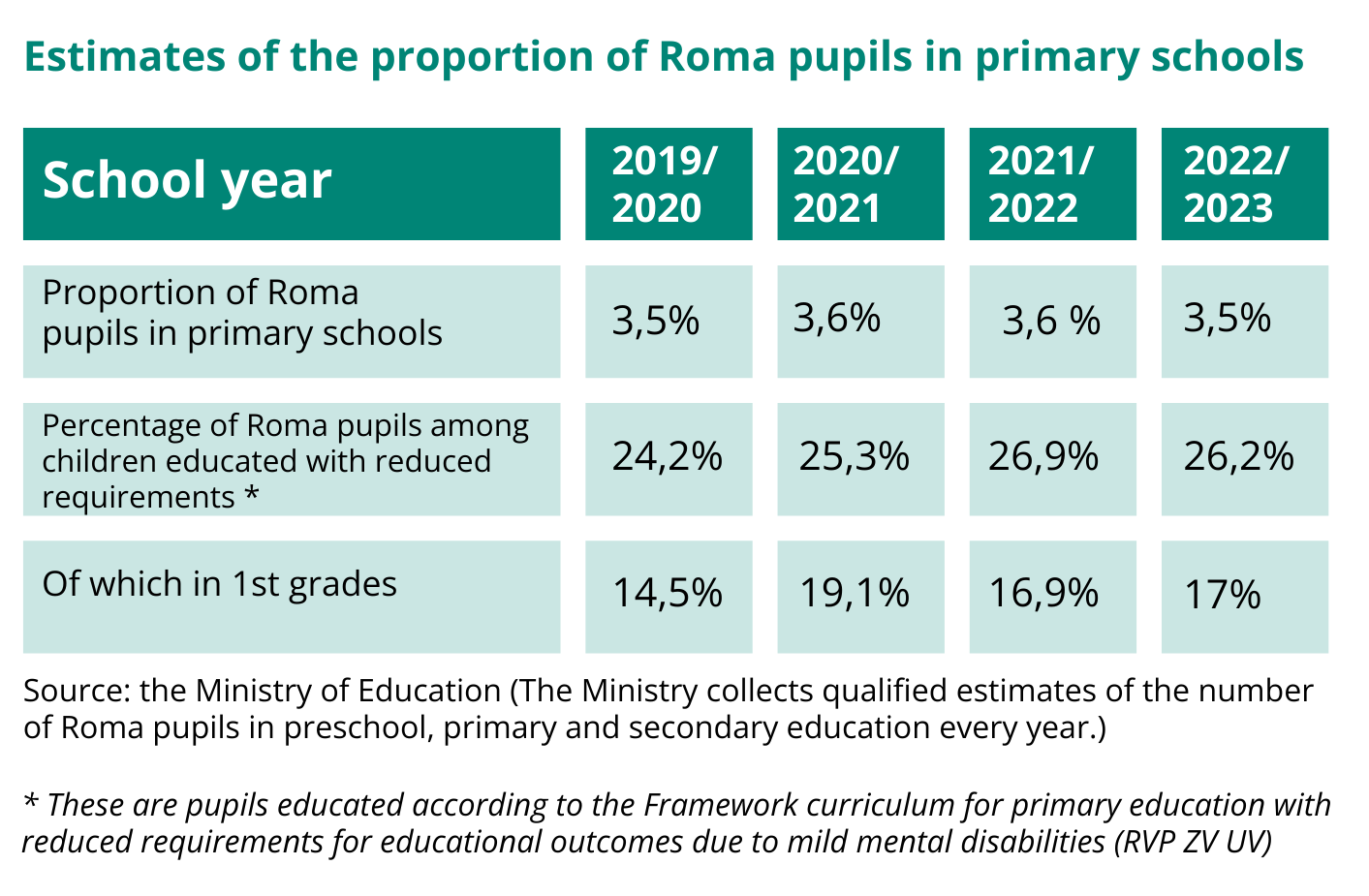
As in previous years, current data from the Czech Ministry of Education show that Romani pupils are roughly 10 times more likely to leave psychological counseling centres with a diagnosis of mild mental disability than their non-Romani classmates. According to the Ombudsman, in the three years when he has been monitoring this topic, the situation in Romani education has not improved much. On average 3.5% of primary school pupils are of Roma origin. However, over a quarter (26.2%) of pupils educated according to the rules with reduced requirements, designed specifically for children with mild mental disabilities, are Roma. Such a disproportion raises questions about whether equal treatment of Roma in access to and provision of education is ensured.

The Ombudsman warned already last year, that pedagogical-psychological counseling centers often fail to recognize the difference between mild mental disability and social disadvantage of children due to outdated diagnostics. The consequences of the complicated social background of Romani children can thus be misinterpreted by psychologists and special educators as mental disability. This has a major impact not only on the education of these children, but above all on their future employment and their lives in general.

According to the Ombudsman, the situation could be improved by using more appropriate diagnostic tools that can better detect the possible impact of social disadvantage. These include tests that focus on mapping child's cognitive processes or tests tracking the development of child's abilities over time, rather than comparing the results to a predetermined scale of assessments. However, available information suggests that the replacement of outdated diagnostic tools by more modern ones is slow.

eng_monitorovaci_zprava_-_tabulka_1.png

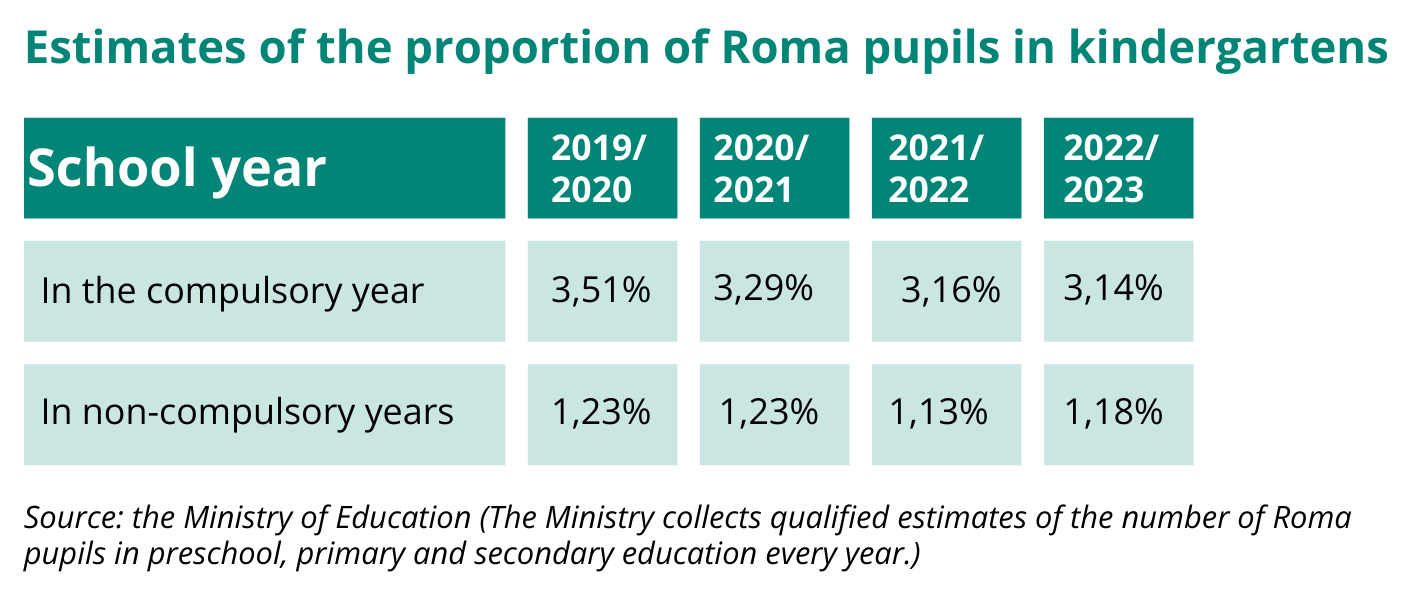
The Ombudsman monitors preschool education for Romani children as well, because kindergartens can help children to compensate for the disadvantages of the environment. However, the proportion of Roma children in the non-compulsory years of kindergartens is still low and even decreasing in the compulsory years.

monitorovaci_zprava_-_tabulka_oprava.png

Although the situation in the education of Romani pupils has not changed in many respects, the Ombudsman acknowledged as a great success the completion of extensive research focused on the impact of compulsory year of preschool education on the education of Romani pupils. In this research, the authors of the study in socially excluded localities, among other things, investigated the main reasons for the non-participation of Romani children in preschool education. Because the parents themselves did not attend kindergartens, they have no idea about their advantages and therefore often do not enlist their children there either. Some parents did not know that children of unemployed parents can also attend kindergartens. Last but not least, in addition to the lack of kindergartens close to home, the insufficient capacity of kindergartens also plays a role.

The Ombudsman monitors the implementation of the right to equal treatment and protection against discrimination in several areas thanks to the Norway Grants project "Reinforcing the activities of the Public Defender of Rights in the protection of human rights"[1]. In the monitoring reports, he provides information on the development of the monitored indicators of the level of equal treatment in the field of education of Roma children and two other monitored areas - equal pay for women and men and procedural issues.

The final monitoring report will follow now. The Ombudsman will summarise developments in the areas monitored over the entire period of 2020-2023 and add recommendations on what measures should be taken to improve the implementation of the right to equal treatment in the areas concerned.


[1] Reinforcing the activities of the Public Defender of Rights in the protection of human rights (with the aim of establishing a National Human Rights Institution in the Czech Republic), No. LP-PDP3-001. The project is part of Human Rights Programme financed from  the Norway grants 2014-2021 through the Czech Ministry of Finance.


Print

Read more

Statements regarding a municipality setting a requirement of e-identification to support proposals from residents in the municipality; also an issue of the framework of JO’s supervision of municipal activities

Date of article: 02/11/2023

Daily News of: 09/11/2023

Country:  Sweden

Author:

Article language: en

Date of decision: 2023-09-26Decision case number: 7393-2022Decision maker: Ombudsman

In its decision, JO makes a statement on the fact that a municipality sets a requirement of the need of e-identification to support proposals from inhabitants in the municipality, so called Nybroförslag (Nybro proposal). JO states that it is a basic requirement that routines and guidelines implemented by an a public authority must comply with the general principle of objectivity in the Swedish constitution, moreover public authorities must be accessible to private citizens who are inexperienced with or distrusts digital services.

According to JO, there may be reason for the municipal board to consider actions that make it possible for private citizens who cannot or do not want to use e-identification to support Nybro proposals.

In its decision, JO also discusses the issue of the framework for JO’s supervision of municipal activity.

When a private citizen visited the public service office to support a Nybro proposal, he did not receive the help he needed to protect his interests. JO criticises the municipal board for this.

Date of decision: 2023-09-26

Read more