
Ombudsman's findings May 2023

Date of article: 24/05/2023

Daily News of: 29/05/2023

Country:  United Kingdom - Scotland

Author:

Article language: en


Findings published this month following investigation by the Ombudsman highlight the importance of good communication, and record keeping. These are particularly important in a health care setting where clear communication and records are needed to show clear reasons for decision making

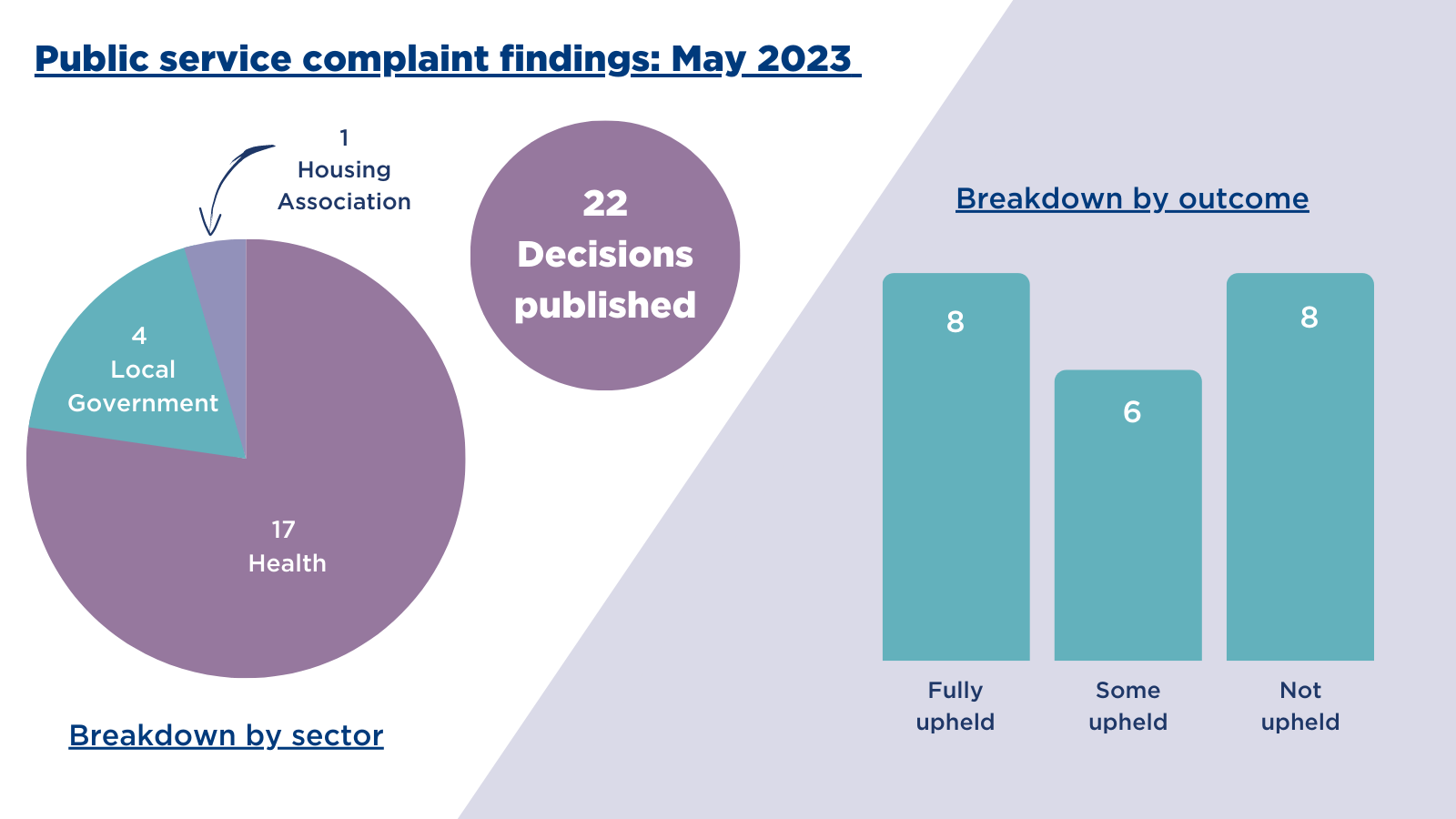
This month we have published decision reports from 22 complaints that were investigated by the Ombudsman. 17 of these were about the Health sector, four about Local Government, and one about a Housing Association. The outcome of these 22 complaints were

  • Fully upheld: 8
  • Some upheld: 6
  • Not upheld: 8

The Ombudsman has also this month published two public reports, which give details of two investigations which made significant finding. She has published these so that others can learn from the findings to prevent similar outcomes in the future. Commenting on one of the cases, the Ombudsman said:

"At the heart of this case is a person who sadly died. My thoughts are with the family, but equally I recognise the  devastating impact of events on all involved. It’s important that we learn from tragic cases such as this to prevent similar failings in the future. My office is here to promote and monitor good complaints handling and provide guidance and support to GP Practices and the wider NHS – just ask if you need help”.

Recommendations made to public bodies

We made 37 recommendations to public bodies. Key themes include the need for clear and consistent communication between public sector organisations and the people they serve.

This is vital for many reasons. People need to know exactly what is happening during their interaction with a service and during a complaint investigation. People also need to know what their rights are if things go wrong and how they can feed back on what went well. It’s important that people understand clearly the reasons for decisions taken by public bodies.

Our findings this month also highlight the importance of following best practice guidance or processes. This is particularly important in a health care setting where these exist to ensure a consistent, good standard of care for patients. If there is a good reason why they weren’t followed it is a good idea to record why and explain this to people.

Finally, our findings show that good record keeping is critical. Good records enable organisations to deliver consistent services, explain their decisions, respond to feedback and complaints, and engage in reflective learning. Being able to give reasons for decisions helps build trust and confidence, and supports transparency in public services.

All our published decision reports can be read in full on our website.

Details of both public reports can be found on our website.

Read more

"Trabajamos para mejorar los derechos de las personas privadas de libertad''

Date of article: 23/05/2023

Daily News of: 29/05/2023

Country:  Spain - Catalonia

Author:

Article language: es

Primera reunión con los doce miembros del Consejo Asesor del Mecanismo Catalán para la Prevención de la Tortura
 

La síndica de greuges, Esther Giménez-Salinas; el adjunto general, Jaume Saura, y la adjunta de infancia, Aida C. Rodríguez, encabezaron ayer la sesión constitutiva del nuevo Consejo Asesor del Mecanismo Catalán para la Prevención de la Tortura (MCPT), que tuvo lugar en la sede del Síndic de Greuges de Catalunya y en la que participaron los doce miembros que integrarán el Consejo Asesor durante los próximos seis años. Los nuevos miembros fueron nombrados el pasado 3 de mayo por el Parlamento de Catalunya.

La institución del Síndic de Greuges actúa como Mecanismo Catalán para la Prevención de la Tortura en virtud del Protocolo facultativo de la Convención contra la Tortura y Otros Tratos o Penas Crueles, Inhumanos o Degradantes, adoptada por la Asamblea General de las Naciones Unidas. Esta competencia le habilita para visitar espacios donde se encuentran personas privadas de libertad, como centros penitenciarios, comisarías, centros de menores o centros psiquiátricos. Estas visitas permiten al equipo del MCPT detectar aspectos susceptibles de mejora y realizar recomendaciones a las autoridades competentes, que quedan recogidas en un informe que anualmente se entrega al Parlamento de Cataluña.

El MCPT cuenta con dos órganos de trabajo que se han creado con la voluntad de fomentar la participación de la sociedad civil: el Consejo Asesor, integrado por un grupo multidisciplinar de profesionales que cubre los campos específicos del derecho, la salud y los derechos humanos, y que tiene la función de guiar y formular propuestas de actuación; y el equipo de trabajo, que es quien realiza las visitas periódicas y trabaja sobre el terreno.

Los doce miembros del Consejo Asesor son: 

• Jesús M. Sánchez García (Ilustre Colegio de la Abogacía de Barcelona)

• Maria Pastor Santana (Ilustre Colegio de Abogados de Mataró)

• Gloria Jodar i Solà (Consejo de Colegios de Enfermeras y Enfermeros de Cataluña)

• Rosa Servent Pedescoll (Colegio de Médicos de Barcelona)

• Jaume Bosch Mestres (experto en el ámbito de seguridad)

• Núria Terribas Salas (Fundación Grífols)

• Aina Estarelles Roca (Iridia)

• Emilie Marie Rivas (Save the Children)

• Josep Joan Moreso Mateos (Universidad Pompeu Fabra)

• Alejandro Forero Cuellar (Universidad de Barcelona)

• Benet Salellas i Vilar (abogado)

• David Román Fernández (educador social)

Read more

Sozialsprechstunde: Bürgerbeauftragte berät in Lübeck

Date of article: 23/05/2023

Daily News of: 29/05/2023

Country:  Germany - Schleswig-Holstein

Author:

Article language: de

Probleme beim Bürgergeld, wie zum Beispiel mit der Übernahme der Kosten für Miete oder Heizung, mit der Hilfe zum Lebensunterhalt, dem Wohngeld oder auch mit Leistungen der Krankenkassen oder Schwierigkeiten beim Kindergeld ­ die Bürgerbeauftragte für soziale Angelegenheiten des Landes Schleswig-Holstein, Samiah El Samadoni, hilft bei allen Fragen rund um das Sozialrecht. Darüber hinaus berät die Bürgerbeauftragte auch als Leiterin der Antidiskriminierungsstelle des Landes und als Ombudsperson in der Kinder- und Jugendhilfe im Rahmen dieser Sprechstunde. Zudem ist die Bürgerbeauftragte auch Beauftragte für die Landespolizei und damit Ansprechpartnerin für Beschwerden von Bürger*innen und Eingaben von Polizist*innen.

(...)

Read more

Mikko Sarja new Deputy Ombudsman

Date of article: 22/05/2023

Daily News of: 29/05/2023

Country:  Finland

Author:

Article language: en

The Parliament of Finland has elected LL Lic., LL.M. Mikko Sarja to serve as Deputy Ombudsman. Sarja has previously acted as a substitute for a Deputy Ombudsman and Senior Legal Advisor at the office of the Parliamentary Ombudsman.

His term will begin on 1.6.20223 and end on 31.5.2027. 

Parliament elects the Ombudsman and Deputy-Ombudsmen for terms of four years at a time. Before the election, the Constitutional Law Committee assesses those who have submitted their candidatures. The Ombudsman is elected by secret ballot.

Read more

Percorsi universitari e professionali per le attività trattamentali

Date of article: 22/05/2023

Daily News of: 29/05/2023

Country:  Italy - Marches

Author:

Article language: it

Accordi sottoscritti dal Garante Giulianelli per diversi istituti marchigiani e per la Rems di Macerata Feltria. Rinnovato quello che va a interessare l’agricoltura sociale

Nuovi accordi sottoscritti dal Garante Giancarlo Giulianelli per quanto riguarda le attività trattamentali negli istituti penitenziari delle Marche. Attraverso il protocollo d’intesa con Prap (Amministrazione penitenziaria di Emilia Romagna e Marche) e Università Politecnica delle Marche previsti l’istituzione ed il funzionamento del Polo universitario penitenziario a Montacuto e Barcaglione.

Per il triennio accademico 2022 – 2025 con l’Università di Urbino si rinnova, invece, l’attività del Polo universitario regionale presso la Casa di reclusione di Fossombrone.

Un’esperienza portata avanti ormai da anni e che nel 2017 ha raccolto anche l’adesione del Garante. Il 24 novembre del 2021 è stato siglato un nuovo protocollo d’intesa tra Prap, Università e la stessa Autorità di garanzia.

Nel marzo scorso avviato il secondo corso di “aiuto cuoco” per il Polo professionale presso gli istituti penitenziari di Ancona – costituito nel 2017 tra Garante, Regione e Prap – e rinnovato l’accordo con l’Amap (“Agenzia Marche Agricoltura Pesca”, ex Assam) per il progetto “Agricoltura sociale negli Istituti penitenziari di Ancona”. Obiettivo generale è quello di fornire ai detenuti l’acquisizione e il miglioramento delle competenze professionali di settore.

Previsti diversi corsi di specializzazione, attività specifiche come il ripopolamento e la diffusione della “gallina Ancona” e uno studio sociologico inerente l’impatto dell’agricoltura sociale sull’ecosistema penitenziario. Nel corso del tempo l’attivazione dell’iniziativa, anche con la collaborazione di Coldiretti, ha dato vita a una fiorente attività e proprio di recente la “Fattoria Barcaglione” è stata accreditata nell’albo nazionale della rete delle aziende agricole che fanno capo alla Fondazione di “Campagna Amica”.

Infine, “Al di qua del muro… L’infinito”, progetto che va ad interessare la Rems (Residenza per l’esecuzione delle misure di sicurezza) “Casa Badesse” di Macerata Feltria, gestita dalla società “Atena”. In questo caso si registra la collaborazione tra Garante e Comune e l’iniziativa ripropone, per il prossimo triennio, la realizzazione dell’atelier d’arte di ceramica raku (antica tecnica giapponese) attività già avviata in passato da “Atena” con risultati positivi. “La natura”, “Il viaggio” e “I passaggi del sogno” sono i temi annuali proposti agli ospiti della Rems.

Read more