On Thursday, the Committee on Petitions will host an interinstitutional event to launch a call for applications for the 2026 European Capitals of Small Retail Award.
Follow the webstreaming of the event (live interpretation available).
The event, organised by the Committee on Petitions, marks the opening of the application period for cities across Europe to compete in the first edition of the European Capitals of Small Retail (ECoSR) Award.
It will be chaired by Bogdan Rzońca (ECR, PL), Chair of the Committee on Petitions, and moderated by Vice-Chair Dolors Montserrat (EPP, ES). Speakers will include representatives from the European Commission, the Committee of the Regions, and the European Economic and Social Committee.
From 2026, the ECoSR Award will annually recognise three European cities - one small (5,000-50,000 inhabitants), one medium (50,000-250,000), and one large (over 250,000) - for the support they give to small retailers and their efforts to sustain vibrant city centres.
Next steps
The application deadline is 9 October 2025 at 14:00 CET. A panel of experts will evaluate the candidates, and publish a shortlist of selected cities by the end of November. The official award ceremony will take place in Brussels in January 2026.
Background
In 2023, following a petition submitted to the European Parliament, MEPs adopted a resolution calling for the creation of the ECoSR. The initiative was subsequently included in the 2024 EU Budget.
The ECoSR initiative aims to promote the value of small retailers across Europe. These businesses are not only central to local economies and employment, but also play a vital role in maintaining the social fabric of urban and rural communities.
The winning cities will benefit from non-financial rewards such as increased recognition at EU level, year-round promotional support, access to networking events, and participation in exchange programmes for small businesses. They will also receive assistance in organising workshops and webinars, professional video production, and enhanced city branding to boost tourism visibility.
On June 17-19, 2025, the First Deputy Public Defender of Georgia, Tamar Gvaramadze, paid an official visit to New York (USA), where she participated in the Annual Meeting of the Global Alliance of National Human Rights Institutions (GANHRI) and the TriPartite Partnership to Support National Human Rights Institutions.
The event was organized by the United Nations Development Program (UNDP) in cooperation with the Office of the UN High Commissioner for Human Rights and the Global Alliance of National Human Rights Institutions (GANHRI).
During both meetings, the First Deputy Public Defender participated, on the one hand, as a member of the Board of the European Network of National Human Rights Institutions and a temporary substitute for the Chairperson, as well as a representative of the National Human Rights Institution, a beneficiary of the Trilateral Cooperation Programme.
During the meetings, Tamar Gvaramadze presented several reports, namely; as the substitute for the Chairperson of the ENNHRI Board, she spoke about the human rights situation across Europe, challenges, and the activities of ENNHRI member institutions, and as a representative of the Public Defender of Georgia, she introduced the attendees to the activities of the Public Defender's Office, the special report prepared by the Public Defender on the supervision of the realization of the right to live in a healthy environment and access to water, and the future plans of the Office in this direction. In one of her reports, Tamar Gvaramadze also spoke about the impact of digital technologies on human rights and highlighted the special report and activities prepared by the Public Defender's Office in this regard.
Gabriela R. braucht einen elektrischen Rollstuhl. Sonst könnte sich die 62-Jährige nicht allein fortbewegen, und sei es nur von einem Zimmer ins andere. Die frühere Behindertenfachbetreuerin hat eine Erkrankung des zentralen Nervensystems und Pflegestufe 6. Einen normalen Rollstuhl kann sie nicht antreiben – trotzdem will ihr die ÖGK keinen elektrischen bezahlen. Obwohl sie ärztliche Verordnungen und Empfehlungen dafür hat. „Immer wieder beschweren sich Menschen bei der Volksanwaltschaft, weil ihnen mit fadenscheinigen Begründungen Hilfsmittel wie Elektrorollstühle verweigert werden – und sehr oft kommt die Ablehnung von der Tiroler ÖGK-Außenstelle“, sagt Volksanwalt Bernhard Achitz. Zuletzt im August 2024 hat er zwei Fälle in der ORF-Sendung „Bürgeranwalt“ thematisiert, wo die Rollstühle dann erst nach Einschreiten der Volksanwaltschaft finanziert wurden. Achitz: „Ich erwarte aber, dass die ÖGK ihre Fehler nicht nur korrigiert, wenn die Volksanwaltschaft einschreitet, sondern in künftigen Fällen gleich patientinnenfreundlich handelt.“
Ist Lienz zu weit weg für eine persönliche Begutachtung?
„Die Rechtslage ist eindeutig“, so Achitz in der „Bürgeranwalt“-Sendung am 28. Juni 2025, „sowohl das ASVG als auch die UN-Behindertenrechtskonvention verlangen, dass Hilfsmittel wie Elektrorollstühle zur Verfügung zu stellen sind, wenn sie notwendig sind, um Menschen persönliche Mobilität zu ermöglichen.“ Im konkreten Fall von Gabriela R. kritisierte Achitz die fragwürdigen Begründungen, mit denen die ÖGK Tirol den Rollstuhl abgelehnt hat: „Zuerst hieß es, sie kann eh noch mit Rollator gehen und braucht daher keinen Rollstuhl. Später dann: Sie ist zu krank, um den Elektrorollstuhl sicher bedienen zu können.“ Das schloss der Chefarzt der ÖGK offenbar aus allgemeinen Informationen über die Erkrankung. Persönlich überzeugen wollte sich die ÖGK davon allerdings nicht. Laut Aussage der Familie von Gabriela R. würde die ÖGK solche Begutachtungen nur in Innsbruck und Umgebung machen – der Weg nach Osttirol, wo R. lebt, war offenbar zu weit.
England’s Health Ombudsman has warned of concerns about the diagnosis and care of stroke patients after the number of its investigations rose by two-thirds.
The Ombudsman is urging clinicians to act quickly when they suspect a stroke, even if the patient presents with atypical symptoms. It is also important that clinicians involved in a patient’s care work together and communicate well to provide joined-up treatment.
Between 1 April 2021 and 31 March 2025, the Parliamentary and Health Service Ombudsman (PHSO) saw a 25% rise in complaints and a 65% rise in the number of investigations related to strokes.
The Ombudsman has seen repeated failings in diagnosis, nursing care, communication, and treatment.
Rebecca Hilsenrath KC (Hon), Chief Executive Officer, Parliamentary and Health Service Ombudsman, said:
Over the past four years we have seen a significant rise in the number of complaints and investigations related to people who have suffered a stroke, including typical and atypical presentations. This is particularly concerning as early diagnosis is crucial in giving patients the best opportunity for successful treatment and recovery.
“These investigations all represent instances where organisations involved have not identified a failing. It is important that the NHS operates in a learning culture and that when things go wrong clinicians recognise what has happened and put it right for those involved, as well as improve care and treatment for future patients.”
PHSO recently carried out an investigation following the death of 86-year-old George Fawcett. His family complained to the Ombudsman after previously raising their concerns about George’s treatment with the University Hospital of North Durham and being unhappy with their response.
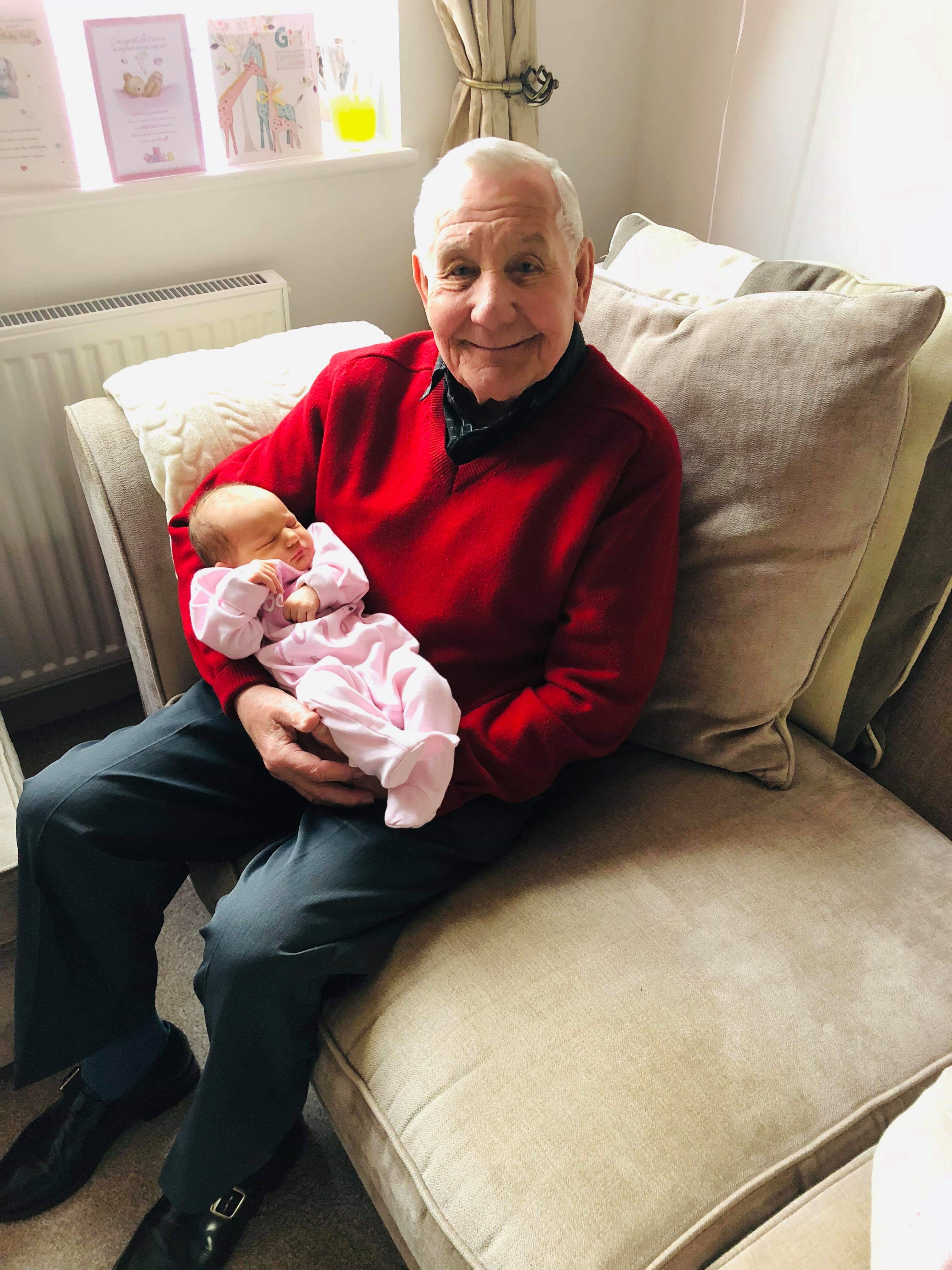
The great-grandfather-of-two from Spennymoor, County Durham died after suffering a spinal stroke which was not diagnosed for nine days. The Ombudsman found that with an earlier diagnosis he might have lived longer, potentially giving him and his family a few additional days together.
George Fawcett with one of his great-grandchildren
George, a former ambulance driver in the RAF, was admitted to the University Hospital of North Durham in May 2021. He was having chest pain, weakness in his legs and arms, and there had been a rapid decline in his mobility leading to paralysis.
An MRI was ordered but he was not immediately referred to the neurology department as he should have been. Then, after his scans were reviewed, he was wrongly referred to the orthopaedics department.
The orthopaedics team sent George back to neurology where doctors suspected he might have had a spinal stroke.
Doctors should have referred him to a stroke unit within 24 hours but he was not seen by a stroke consultant until four days later.
It was another three days before he was moved to a specialist unit at another hospital run by a different Trust. Clinicians there diagnosed him with a spinal stroke.
George died two days later. His cause of death was heart failure and a heart attack, the secondary cause was a spinal stroke.
While the Ombudsman found George’s death to be unavoidable, they concluded there were serious failings and his care fell below the standard expected.
The PHSO investigation concluded that his stroke should have been diagnosed earlier than it was. Had this happened, he would have been moved to a specialist stroke centre earlier
The Ombudsman also found that George was denied a dignified death as he developed pressure sores that weren’t treated properly at the University Hospital of North Durham.
PHSO recommended that the hospital Trust create an action plan to prevent this happening again and also apologise to George’s family and pay them a financial remedy. The Trust has agreed to comply.
George’s family initially complained to PHSO about other aspects of his care and were unaware until the Ombudsman began its investigation that he had suffered a stroke as early as he did and that doctors had failed to identify it.
George’s daughter, Sandra Todd, said:
The care my dad received was nowhere near the level it should have been and felt very fractured. We were raising concerns with the hospital all the time but no one would listen to us. That’s why we approached the Ombudsman, so that there could be an independent investigation into what happened and that’s how we finally learned the truth.
“My dad had some underlying health problems and had had a stroke 14 years earlier, but before he went to hospital he was independent, mobile, playing bowls several times a week, going shopping independently, and seeing his friends.
“But the doctors at the hospital just seemed to dismiss him as an old man with mobility problems. They didn’t see what was really happening. Given his history of having a stroke before and his symptoms at the time, it was devastating to find out that they completely missed the signs.
“We complained to the Ombudsman so that we could get justice for George and prevent this from happening again. We hope something positive will come from what the Ombudsman has found so that others don’t have to go through the same experience.”

 Ukraine