Following the Protector of Citizens’ Recommendation, MOI changed the manner of handling citizens’ submissions

Date of article: 14/10/2020

Daily News of: 14/10/2020

Country:  Serbia

Author: Protector of Citizens -Ombudsman of Serbia

Article language: en

Following the Protector of Citizens’ Recommendation, the Ministry of Interior issued an order to all organizational units to change the existing manner of handling citizens’ submissions, meaning that the decisions on citizens’ requests need to be made as administrative acts i.e. to include the rationale and the instruction on legal remedy.

Upon completing the procedure of controlling the work of the Ministry of Interior in August 2020, the Protector of Citizens issued a Recommendation to the Ministry to qualify future citizens' submissions according to the content, to apply measures and activities within its competence and to decide in legally specified form, bearing in mind that in handling citizens’ requests in the past, it did not decide in the form of an administrative act.

The Ministry of Interior informed the Protector of Citizens that it had sent a recommendation on changing the manner of work to Ministry’s organizational units, which within their competencies applied the Law on General Administrative Procedure, for consistent implementation in the future.

Read more

(Equinet) Roundtable today on the future of equality legislation in Europe

Date of article: 14/10/2020

Daily News of: 14/10/2020

Country:  EUROPE

Author:

Article language: en

Advancing the EU legal framework for equality and its implementation 

During the last decades, and with the approval of the 2000 Directives (Race Equality Directive and the Framework Directive),  EU equality and anti-discrimination legislation grew from the ground of gender to other grounds such as ethnic and racial origin and age, disability, sexual orientation and religion or belief. The EU was progressively protecting more and more citizens from discrimination, harassment and violence.   

Nonetheless, EU anti-discrimination law does not equally protect all vulnerable groups in Europe. The  draft EU “Horizontal Directive”pending since July 2008 aims to offer more symmetric protection to victims of discrimination and would extend the mandate of Equality Bodies to also cover discrimination based on disability, sexual orientation, religion or belief, age and the intersectional and multiple discrimination that results from the combination of these grounds. This would be a milestone for building a fairer and more equal Europe.   

Equality is a necessity and not a luxury. Strong laws are needed to ensure that all inhabitants of the EU can be protected, especially in times of crisis. We need to progress, taking into account the learnings from this year and the last decades, in constructing a strong, complete and inclusive legislative framework to ensure that no one is left behind.  

Online Roundtable: Future of Equality Legislation in Europe

On 14 October 2020 (14:00 – 16:00 CET) Equinet will organize an online roundtable, together with MEP Alice Bah Kuhnke, on the future of equality legislation in Europe. The primary objective will be to discuss the EU legal framework for equality and its implementation as well as advancing the adoption of the Horizontal Directive. The roundtable will bring together members of the European Parliament and representatives of Equality Bodies to assess the current state of the EU legal framework for equality and identify ways of improving it. By focusing on potential areas of improvement in implementing the existing equality directives, the focus will be particularly on the Horizontal Directive and identifying possible future actions to advance equality and non-discrimination in Europe.  See the speakers bios here.

The event is open to the public and will be livestreamed on our Facebook page.  

Please contact Jone Elizondo Urrestarazu (jone.elizondo@equienteurope.org) if you have any questions regarding this event.

Agenda

Download the Agenda here

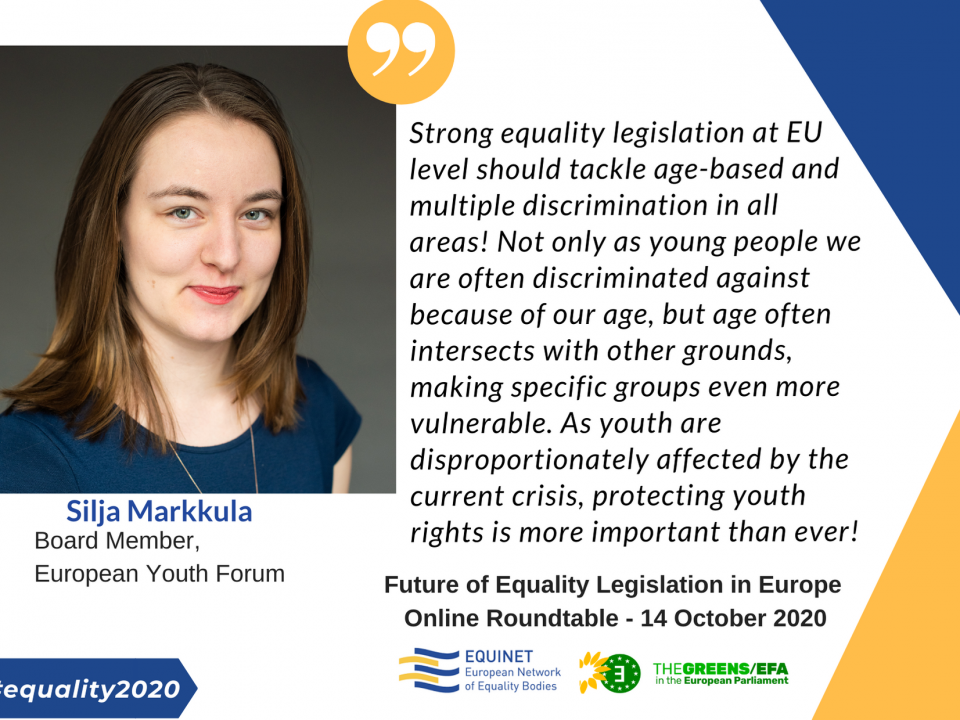
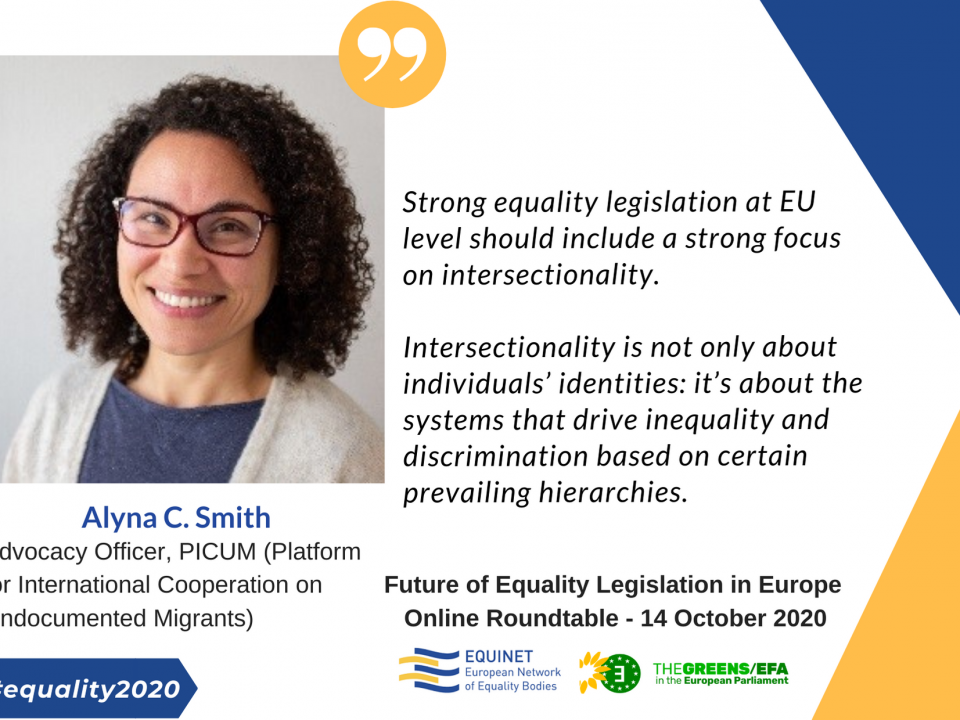
Importance of Strong Equality Legislation for Civil Society

The online format of this event means that it’s shorter than we would have wished and we cannot include all voices on the day. In order not to leave the very important voices of Civil Society Organisations out of the conversation however, we have asked them to tell us why strong equality legislation is important to them…

Read more

Die Bürgerbeauftragte informiert: Verlängerung von Sonderregelungen der Pflegeversicherung aufgrund der Corona-Pandemie

Date of article: 14/10/2020

Daily News of: 14/10/2020

Country:  Germany - Schleswig-Holstein

Author:

Article language: de

Die Maßnahmen zur Aufrechterhaltung der pflegerischen Versorgung während der Corona-Pandemie wurden durch das Krankenhauszukunftsgesetz (KHZG) bis zum 31. Dezember 2020 verlängert. „Für Pflegebedürftige lohnt es sich zu überprüfen, ob Ihnen für die Dauer der Corona-Pandemie zuvor verwehrte Leistungen der Pflegeversicherung zustehen“, sagte die Bürgerbeauftragte für soziale Angelegenheiten des Landes Schleswig-Holstein, Samiah El Samadoni, heute (Mittwoch) in Kiel.


In Ihren Beratungen stellte die Bürgerbeauftragte während der letzten Monate vermehrt fest, dass Pflegebedürftige über den vereinfachten Zugang zu einigen Pflegeleistungen während der Corona-Pandemie nicht informiert sind. „Zum Beispiel können die Pflegekassen momentan bei pflegerischen Versorgungsengpässen im häuslichen Bereich die Kosten für alternative Versorgungen erstatten“, erklärte die Bürgerbeauftragte. Auch die Möglichkeiten zur Inanspruchnahme des Entlastungsbetrages seien ausgeweitet.


(...)

Read more

El Síndic investiga los impagos de las ayudas a las residencias para hacer frente a la pandemia

Date of article: 14/10/2020

Daily News of: 14/10/2020

Country:  Spain - Catalonia

Author:

Article language: es

El Decreto ley 29/2020 fijó diversas ayudas económicas que, según los medios de comunicación, no se han pagado

También estudia el cierre de algunas residencias por carencias asistenciales graves en la atención a las personas residentes en esta segunda ola de COVID
 

El Síndic ha tenido conocimiento a través de los medios de comunicación que algunas residencias geriátricas y centros de día acumulan deudas importantes ante los impagos de la Generalitat de unas ayudas comprometidos durante el mes de julio para hacer frente a los costes sobrevenidos por la pandemia de la COVID-19.

En este sentido, el 28 de julio la Generalitat activó dos ayudas para los servicios que atienden a personas dependientes. A través del Decreto ley 29/2020, el Departamento de Trabajo, Asuntos Sociales y Familias fijó varias ayudas económicas. Uno, de 196 euros mensuales por cada plaza geriátrica en residencias, y otro, de 60 euros por usuario de centro de día, para compensar los costes de material y de personal. El mismo decreto también establecía la financiación del 85% del precio medio ponderado de la Cartera de servicios sociales de carácter residencial de personas mayores para las plazas reservadas de libre ocupación. Esta segunda ayuda tenía por objetivo facilitar los aislamientos dentro de las residencias.

A pesar de todo lo anterior, los medios de comunicación informan que estas ayudas no se han hecho efectivas y esta circunstancia ha hecho que muchos centros se encuentren al límite de su tesorería.

Con el objetivo de esclarecer esta situación, el Síndic ha iniciado una investigación y, para averiguarlo, se ha dirigido al Departamento de Trabajo, Asuntos Sociales y Familias para que le informe acerca del estado de las ayudas mencionadas, si se han hecho efectivas o no, o de la previsión de cuándo se llevarán a cabo.

El Síndic también ha abierto otra actuación de oficio en relación con el cierre de algunas residencias durante esta segunda ola ante la constatación de carencias asistenciales graves en la atención a las personas residentes. El objetivo es conocer el número de residencias clausuradas, los protocolos de actuación que se han utilizado y las derivaciones de usuarios que se han efectuado.

Read more

Partenariat Ouest-France : Couple homosexuel, nous n’arrivons pas à adopter

Date of article: 13/10/2020

Daily News of: 14/10/2020

Country:  France

Author:

Article language: fr

Mariées depuis trois ans, Agathe et Elsa ont décidé d’adopter un enfant. De nombreux services d’adoption organisent des réunions d’information à destinations des postulants à l’adoption. Cependant lors de l’une de ces réunions, les services d’adoption de leur département leur ont signalé que la procédure serait plus compliquée et plus longue que pour les couples hétérosexuels. Elles se demandent si ce traitement peut être qualifié de discriminatoire. Que dit la loi ?

En France, les articles 343 et 343-1 du Code civil garantissent que l’adoption peut être demandée par deux époux, mariés depuis plus de deux ans ou âgés l’un et l’autre de plus de 28 ans ou par toute personne âgée de plus de 28 ans. Depuis la loi n° 2013-404 du 17 mai 2013 ouvrant le mariage aux personnes de même sexe, l’adoption d’un enfant est ouverte aux couples de même sexe dans les mêmes conditions.

Si le Conseil de famille est notamment fondé à échanger sur les conditions familiales des candidats afin d’apprécier leur aptitude à répondre aux besoins de l’enfant, l’orientation sexuelle est en revanche étrangère aux critères permettant d’évaluer une candidature pour adoption. Elle ne peut donc être prise en compte dans les débats entre les membres du conseil de famille lors de la procédure d’apparentement et ne peut être la cause d’un allongement de délais.

Si vous pensez avoir été victime de discrimination dans un processus d’adoption, vous pouvez saisir le Défenseur des droits par mail ou par le formulaire en ligne ( defenseurdesdroits.fr ). Ou par courrier gratuit et sans affranchissement au siège de l’institution (Défenseur des droits, Libre réponse 71120, 75342 Paris Cedex 07) ou appeler le 09 69 39 00 00 (lundi-vendredi).

Read more