
IOI Ombudsman News 37/2020
Date of article: 25/09/2020
Daily News of: 25/09/2020
Country:  WORLD
WORLD
Author:
Article language: en
|
|||||||||||||||||||||||||||||||||||||||||||
Date of article: 25/09/2020
Daily News of: 25/09/2020
Country: WORLD
Author:
Article language: en
|
|||||||||||||||||||||||||||||||||||||||||||
Date of article: 24/09/2020
Daily News of: 25/09/2020
Country: EUROPE
Author:
Article language: en

The 2020 eGovernment Benchmark report shows remarkable improvements across the board: Over the last two years, every one of the 36 countries measured has improved the digital delivery of public services according to the four benchmarks considered in the assessment. However, the scale of improvement and the overall performance vary substantially.
ssessment. However, the scale of improvement and the overall performance vary substantially.
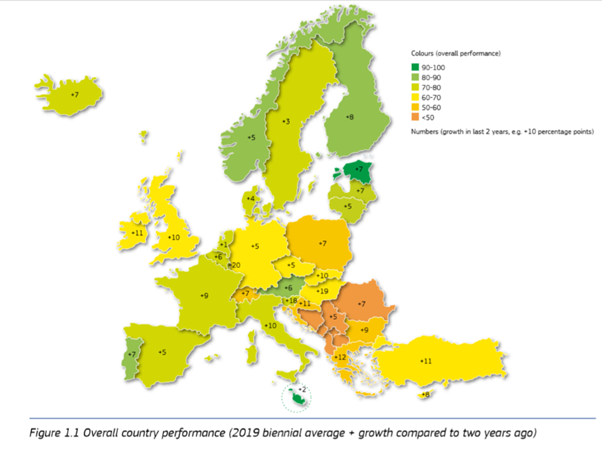
The European frontrunners in eGovernment are Malta (overall score of 97%), Estonia (92%), Austria (87%) and Latvia (87%). These countries score highest across all four top-level benchmarks, followed closely by Denmark (84%), Lithuania (83%) and Finland (83%).
In terms of progress, Luxembourg, Hungary and Slovenia have made the greatest advances in the last two years, rising with 20, 19 and 18 percentage points respectively, resulting in corresponding overall scores of 79%, 63% and 72%.
In order to give a consistent and repeatable means of making valid comparisons, performance of online public services is evaluated against four “top-level” benchmarks. The average score of the four top-level benchmarks represents the overall eGovernment performance of a country, from 0% to 100%
Overall performance is measured as an average score of four top-level benchmarks (which each comprise multiple sub-indicators):
User Centricity – To what extent are services provided online? How mobile friendly are they? And what online support and feedback mechanisms are in place?
Transparency – Are public administrations providing clear, openly communicated information about how their services are delivered? Are they transparent about the responsibilities and performance of their public organisations, and the way people’s personal data is being processed?
Key Enablers – What technological enablers are in place for the delivery of eGovernment services?
Cross-Border Mobility – How easily are citizens from abroad able to access and use the online services
These benchmarks are assessed on the basis of a set of eight life events. Each life event consists of a user journey representing common public services that citizens or businesses will go through. Four life events are measured each year. Hence, the 2020 report presents the findings for data collected in 2018 and 2019.
The data to assess these indicators are collected by Mystery Shoppers. Mystery Shoppers are citizens of each of the observed countries who act as prospective users and follow a detailed, objective and standardised evaluation checklist. The Mystery Shopping has recently been complemented by automated open tools for the assessments of Mobile Friendliness and Cybersecurity.
The EU27+ overall performance stands at 68%. Two years ago, the overall performance sat at 62%.
User Centricity: The focus on end user experience has seen this top-level benchmark increase to 87% (4 percentage points higher than two years ago). More than three out of four public services can be fully completed online (78%). Users can find the services they are looking for via portal websites 95% of the time, and information about these services online nearly 98% of the time.
Of the three sub-indicators, the most recent one, Mobile Friendliness, scores lowest, albeit having seen the highest increase, up from 62% two years ago to 76% today.
(...)
Date of article: 25/09/2020
Daily News of: 25/09/2020
Country:  Spain
- Andalucía
Spain
- Andalucía
Author:
Article language: es
El Defensor del Pueblo andaluz, Jesús Maeztu, ha iniciado una investigación de oficio sobre los servicios de urgencias de atención primaria en los ámbitos rurales. La intención es conocer la reorganización de los mismos por la crisis sanitaria y la previsión temporal para la reanudación de su actividad.
En Andalucía existen 34 Distritos Sanitarios, y vamos a tomar como modelo la provincia de Huelva, en concreto, su Distrito Sanitario Condado-Campiña. Este distrito da cobertura a sus siete Zonas Básicas de Salud, todas ellas de naturaleza rural (La Palma del Condado, Gibraleón, Condado Occidental, Campiña Sur, Campiña Norte, Bollullos Par del Condado y Almonte).
El Defensor del Pueblo andaluz se ha decantado por esta zona tras la comparecencia ante esta Institución de representantes de las alcaldías de tres de los Ayuntamientos incardinados en este Distrito: San Bartolomé de la Torre, de la zona básica de Gibraleón, por un lado y Escacena del Campo y Paterna del Campo, de la zona básica de La Palma del Condado, por otro. Los representantes consistoriales concurrentes nos trasladaban la importancia que el servicio de urgencias dispensado en los centros de salud o consultorios referidos fuera del horario matutino ordinario y dotado con un vehículo tipo ambulancia, representa para sus respectivas poblaciones, por su ubicación y entorno y la elevada edad de sus vecinos, haciéndose eco del rechazo de estos frente a la suspensión de la actividad del punto fijo del servicio de urgencias de atención primaria, al haberse determinado concentrar la atención urgente en un solo centro dentro de la zona básica de salud.
Date of article: 25/09/2020
Daily News of: 25/09/2020
Country:  Greece
Author:
Article language: en
The Ombudsman’s Special Report 2019 analyzes the shortcomings of disciplinary investigations concerning arbitrary incidents in the security forces. Taking into account that allegations of infringement of physical integrity or health during arrest, detention and all kinds of police operations, account for more than half of the complaints examined, the Independent Authority stresses that impartial and thorough disciplinary investigation is an elementary, non-negotiable requirement for the rule of law.
Read Special Report 2019 - National Mechanism For The Investigation Of Arbitrary Incidents
Date of article: 24/09/2020
Daily News of: 24/09/2020
Country:  United Kingdom
- England
United Kingdom
- England
Author:
Article language: en
Hertfordshire County Council has been asked to review its social care practices to ensure it meets its Care Act duties to help people keep their home tidy.
An investigation by the Local Government and Social Care Ombudsman found the council routinely telling people it would not fund support to maintain a habitable home, and that they should find the money themselves.
This contravenes the Care Act, which states being unable to maintain a habitable home environment is one of the key factors which may negatively affect a person’s quality of life.
The Ombudsman investigated a complaint from a woman who has various medical conditions, is cared for in bed, and receives support from the council to be cared for at home.
The council reassessed the woman when her needs changed in 2018 and said her care package could be streamlined and her personal budget reduced.
The Ombudsman’s investigation found the council’s reassessment did not properly define which of the woman’s needs were eligible for support. This makes it unclear (...)


